

The Hidden Cost of Manual Coordination in Mortgage Operations
Many banks have already invested heavily in digital mortgage process optimization. They have modern loan origination systems, digital application forms, automated decision engines and customer portals. Yet mortgage operations continue to become more expensive as application volumes and partner networks grow.
The reason is surprisingly simple. Most digital transformation programmes optimise individual systems, while the operational work increasingly happens between those systems. Documents move through messaging apps, application data is re-entered across platforms, status updates are requested manually and operational teams spend hours coordinating participants instead of processing loans.
In our research and conversations with executive teams from several top-10 banks in Indonesia the same pattern appears repeatedly. The technology stack is rarely the primary constraint. The real bottleneck is manual coordination between developers, agents, operations teams and existing banking systems. We see the same structural challenge across Brazil, where mortgage distribution depends on large partner ecosystems and fragmented operational workflows.
As long as coordination remains manual, every new partner, sales channel or increase in application volume adds operational complexity faster than business value. The result is a hidden cost that rarely appears on a technology roadmap but directly affects processing cost, turnaround time and scalability.
The cost sits between systems
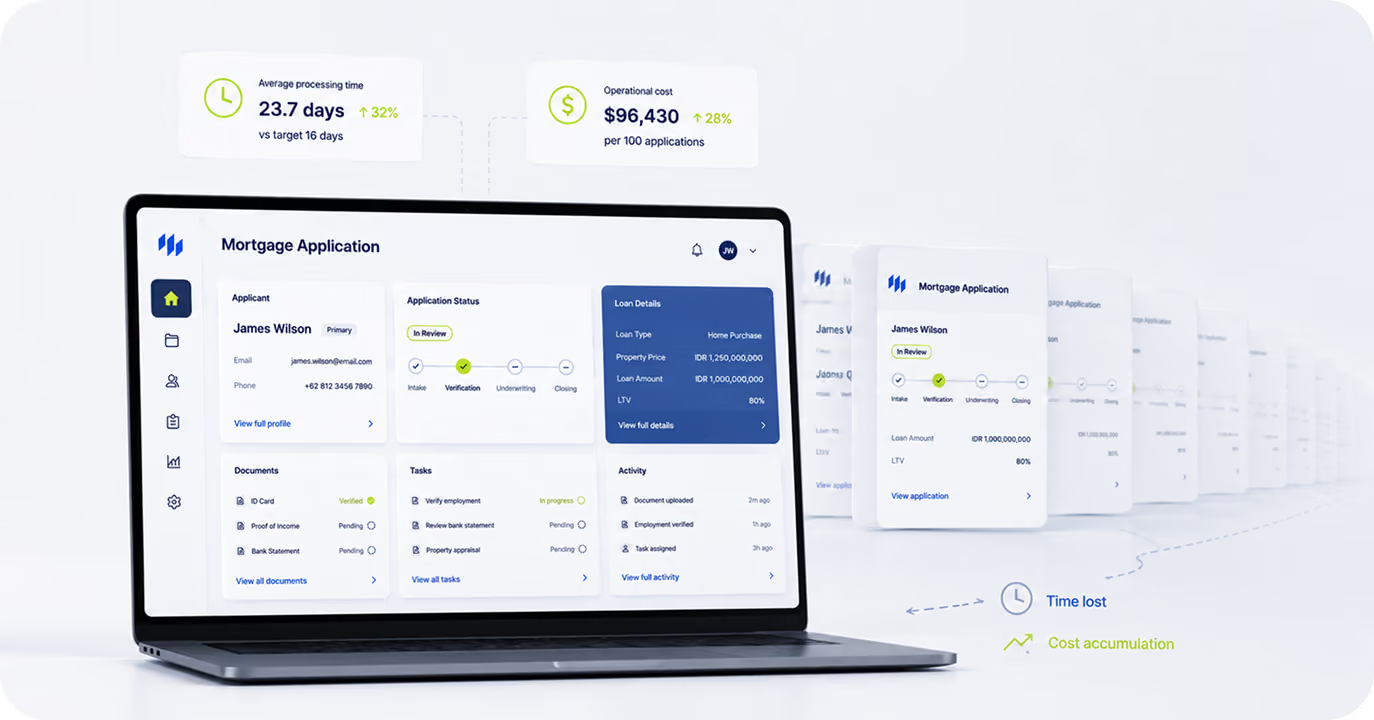
Manual coordination is often treated as administrative overhead. In practice, it directly affects processing costs, service levels, conversion and risk. Consider a mortgage operation handling 10,000 applications per month. If employees spend an average of 30 minutes per application on manual data entry, document checks, follow-ups and status coordination, the bank uses 5,000 working hours before accounting for exceptions.
If 15% of applications require at least another 30 minutes of rework because of missing, inconsistent or incorrectly entered information, this adds 750 hours. At an indicative fully loaded labour cost of $30 per hour, the visible coordination cost reaches approximately $172,500 per month, or $17.25 per application.
This estimate excludes the less visible consequences: delayed approvals, duplicate work, abandoned applications, partner frustration, compliance exposure and the opportunity cost of specialists spending time on administrative tasks.
These figures are illustrative. The correct calculation should use the bank’s own volumes, salaries, rework rates and processing times.
Rework compounds across the mortgage journey
A missing field at the beginning of an application rarely creates only one additional task. It can trigger several rounds of clarification between the customer, agent, developer, sales manager, operations team and credit analyst.
Each handoff introduces another opportunity for information to be delayed, changed or lost. Documents may be submitted through one channel, comments added through another and status updates recorded somewhere else. Teams then spend time reconstructing the application history before they can continue processing it. The resulting delay is often attributed to underwriting, although the application may have spent most of its time waiting for information, ownership or manual verification.
Messaging is part of the operating model
In partner-led markets, messaging applications are already a major interface between banks, agents, developers and customers. They are fast, familiar and well suited to distributed sales networks.
The problem begins when the conversation itself becomes the workflow. Documents are exchanged in chats, status updates depend on individual employees and important decisions remain disconnected from the official application record. A more scalable model keeps messaging as the front door while connecting it to a structured process. Customer identity, application ownership, required documents, validation results, statuses and next actions should be recorded automatically in one operational environment.
This allows the bank to retain the convenience of conversational channels without building the process around personal inboxes and manual follow-ups.
External AI tools create another unstructured layer
Employees increasingly use general-purpose AI tools to summarise documents, draft customer responses or interpret application data. These tools can improve individual productivity, but unmanaged use can also move sensitive information outside the bank’s controlled workflow. The operational issue is broader than data security. When AI-generated outputs are copied manually between applications, chats and spreadsheets, the bank gains no consistent audit trail and cannot systematically improve the underlying process.
AI creates more value when it is embedded into defined workflows: extracting document data, checking completeness, identifying inconsistencies, preparing summaries and recommending the next operational action. Each output can then be linked to the relevant application and reviewed according to the bank’s governance rules.
Manual processes make growth expensive
A mortgage operation built around personal coordination may function at its current scale. As application volumes or partner networks grow, the number of interactions increases faster than the number of completed transactions.
Adding more agents creates more document formats, questions, exceptions and status requests. Adding more operations staff may temporarily protect service levels, but it also increases training requirements and dependence on individual knowledge.
This is why banks in transition often experience a paradox: they have invested in digital channels, yet every increase in volume requires more manual work.
The missing layer is orchestration
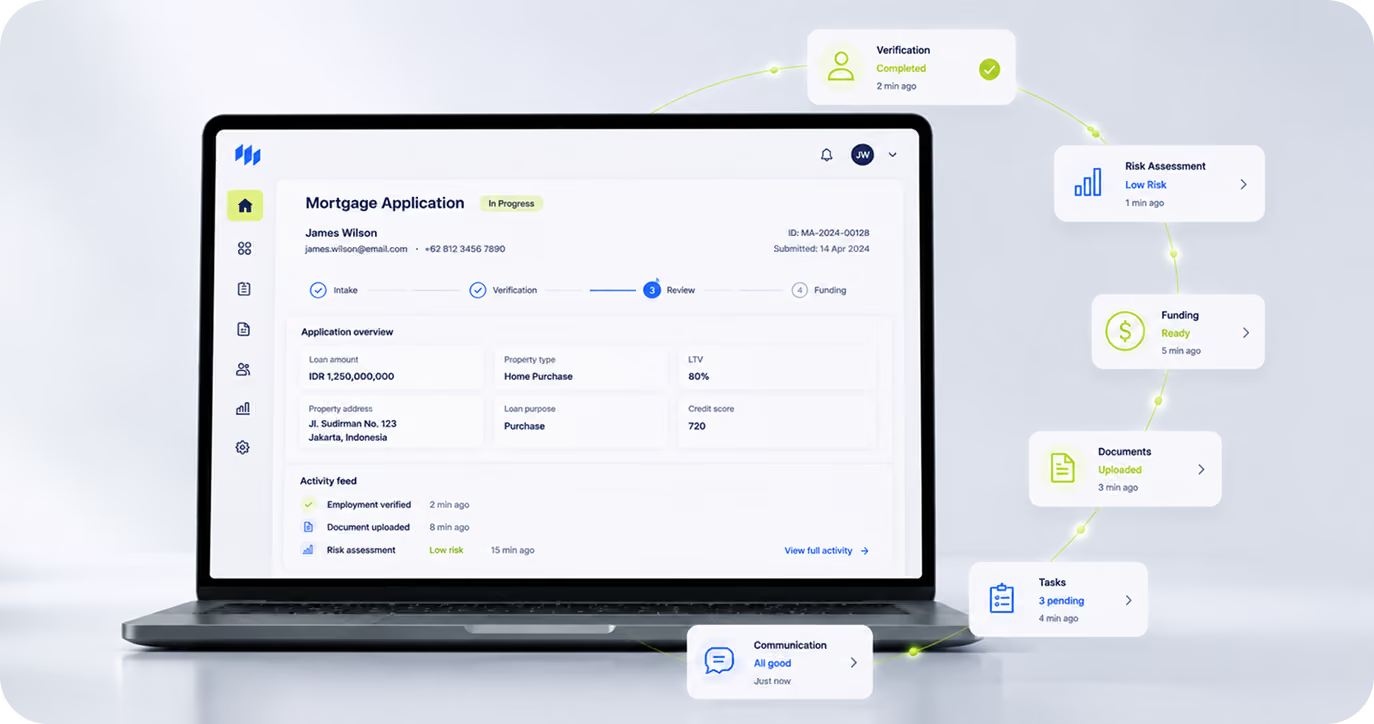
The next stage of mortgage digitalisation is not necessarily another replacement of the core banking or loan origination system. It is the introduction of an orchestration layer between distribution channels, operational teams and existing systems.
The same environment manages application ownership, statuses, exceptions, partner communication and operational history. The bank’s core systems remain authoritative for credit decisions and account processing, while TYMY becomes the operational system of record for the application and partner workflow surrounding them. This approach is particularly relevant for companies in a transition period. It allows them to modernise the highest-friction parts of the process without waiting for a complete replacement of their technology stack.
Measuring the real impact
The value of orchestration should be measured through operational outcomes rather than the number of newly digitalised screens. The most useful indicators include manual minutes per application, first-time-right submission rate, number of follow-ups, return rate, time spent waiting between stages, partner response time and total cost per completed application.
For banks in Indonesia, Brazil and other fast-growing partner-led markets, the objective is no longer simply to digitise individual steps. It is to make the entire application journey operate as one connected process.
Achieving this requires an operational layer that connects application intake, document collection, identity verification, eligibility checks, workflow routing, partner communication and status management across existing banking systems. At TYMY, we have seen this approach reduce manual operational effort by up to 60% and application return rates by up to 50%, without requiring banks to replace their core banking platforms.